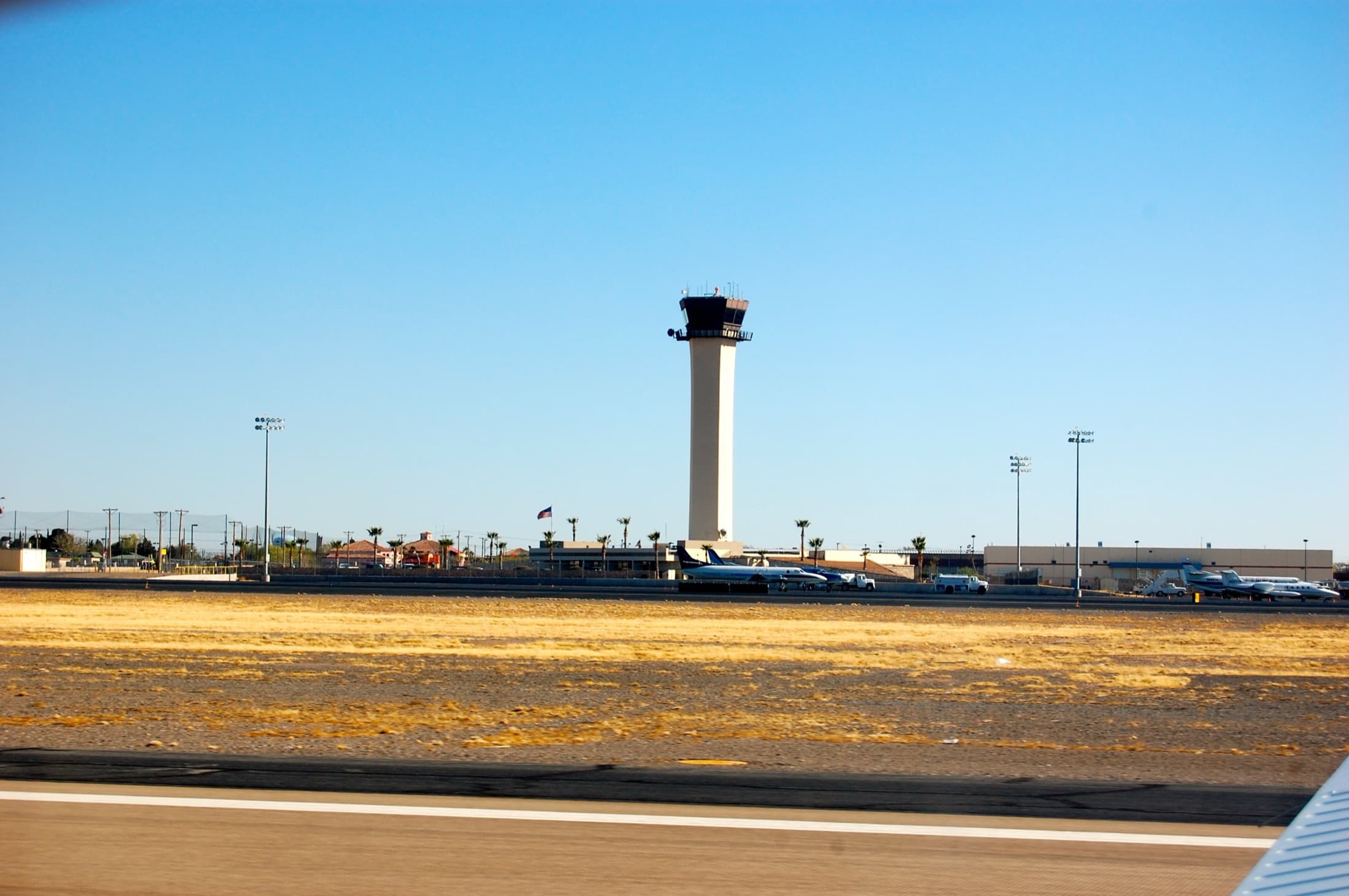

Can air traffic control talk you down?
It has worked. Passengers have been talked onto runways by a voice on the radio, and the transcripts of those flights exist. Read them and one pattern holds: every time it worked, the person talking could fly, and the airplane was small. Here is what controllers are actually required to do for you, what the talkers said, and a way to hear a talk-down with your own hands on the controls.
The rulebook answer: maximum assistance
The controllers' handbook, FAA Order JO 7110.65, opens its emergency chapter with the whole job in one sentence: provide maximum assistance to aircraft in distress. In practice that means your problem outranks everything else on the frequency. The airspace around you gets cleared. The trucks roll before you arrive. And the controller starts pulling in whatever help exists: another facility, a pilot on frequency, an instructor reached by phone. The same chapter defines the words that start it, a distress call is Mayday, said three times, but the record shows plain language works: the 2022 Palm Beach passenger keyed the mic and said his pilot was incoherent and he had no idea how to fly the airplane.
Now the limit. Nothing in the order lets a controller fly the airplane, and the job does not require them to know how. The FAA's own eligibility list for controller applicants is citizenship, age and fluent English; a pilot certificate appears nowhere on it. Some controllers fly anyway, and the cases below show why that coincidence matters.
What the talkers said, in the cases that worked
Palm Beach, May 2022: the controller who guided Darren Harrison, Robert Morgan, was also a flight instructor. He had never flown a Cessna Caravan, so he pulled up an image of its panel and told Harrison what to push, pull and flick, in plain words, one thing at a time. Fort Myers, 2009: controllers handling Doug White's King Air reached a King Air instructor and relayed only the critical steps, because White, a lapsed private pilot, needed type knowledge, not encouragement. Humberside, England, 2013: the airport called flight instructors in to talk John Wildey, who had never piloted an aircraft, through several circuits and a night landing he called a controlled crash.
Three different countries and decades, one shape. The controller's real superpower was not flying skill; it was knowing, within minutes, who to put on the radio. And in every case the instructions that worked were short, concrete, and about one of two things: where the nose points, and how much power is in.
Hear it yourself
Our 90-second landing test ships with a tower that coaches you the same way, chosen from the airplane's state, never at random. These are its actual lines:
- “Two controls. Nose up or down changes your speed. Throttle changes how fast you come down.”
- “You're too low. Push the throttle up a little. Keep the nose where it is.”
- “You're getting too slow. Tip the nose down a little to pick up speed.”
- “Nose down! Push the nose down and give it full throttle.”
- “Throttle all the way down. Slowly bring the nose up. Hold it there.”
Every player hears every word, and most flights still end in the grass or short of the runway, because hearing the rule and flying it are different skills. That gap is the answer to this page's question in miniature: the talk-down gets you information, and information was never the missing part. The landing is a motor skill, learned by repetition, which is why students spend six to 40 hours earning their first solo.
In the browser, sound on.
The full record of passengers who pulled it off, and why none of them was flying an airliner: could a passenger really land a plane?
Learning it with a real instructor, median published rates, 568 schools
Medians of the rates flight schools publish, from our directory. Examiner data puts the typical private pilot at about 72 hours. Checked October 20, 2026.
Opens the estimator.
Talk-down questions
Can air traffic control really talk a passenger through a landing?
In small aircraft, yes, it has been done. In 2022 a controller who was also a flight instructor talked a passenger with no flight experience onto the runway at Palm Beach in a Cessna 208. In 2013, flight instructors called in to Humberside Airport in England talked a 77-year-old who had never piloted an aircraft through a night landing in a Cessna 172. In 2009, controllers put a King Air instructor on the line for a passenger holding a lapsed private pilot certificate. In each case the airplane was small and the coaching came from someone who could fly.
Are air traffic controllers pilots?
The job does not require it. The FAA's stated eligibility requirements for controller applicants are things like US citizenship, age, and fluent English; a pilot certificate is not among them. Some controllers are pilots or instructors on the side, and in the 2022 Palm Beach case that coincidence is exactly what the passenger got. When the controller on duty cannot fly, their move is to find someone who can.
What is ATC required to do in an emergency?
FAA Order JO 7110.65, the controllers' handbook, opens its emergency chapter with the whole job in one sentence: provide maximum assistance to aircraft in distress. In practice that means the emergency gets priority, the frequency and airspace get cleared, equipment is waiting at the field, and the controller pulls in whatever help exists, another facility, another pilot on frequency, an instructor on the phone. What no rule can make them do is fly the airplane. The controls are still in your hands.
What should you say on the radio if the pilot is incapacitated?
Press the push-to-talk switch and say what is wrong in plain words. The formal distress call is Mayday, repeated three times, but the 2022 Palm Beach passenger simply keyed the microphone and said he had a serious situation, his pilot was incoherent, and he did not know how to fly the airplane. That was enough. Controllers are trained to start helping as soon as they understand the problem, not to grade your phraseology.
Could ATC talk you through landing a 737?
There is no case of it on record. Every talked-down passenger landing has been in a small aircraft. An airliner adds a locked flightdeck door, roughly twice the approach speed, and systems that take type-rated pilots weeks to learn, and airline crews fly in pairs precisely so a passenger never has to try.
Sources for this page:
FAA Order JO 7110.65, Chapter 10, Emergencies: “Provide maximum assistance to aircraft in distress”
FAA: Become an air traffic controller (the job's eligibility requirements)
Controller details helping passenger land plane after pilot emergency (TODAY/NBC, May 2022)
Passenger Lands Caravan (AVweb, May 2022)
Unintentional King Air pilot: an interview with Doug White (AOPA, April 14, 2009)
'Hero' Passenger Lands Small Plane After Pilot Fell Ill (NPR, October 9, 2013)
The tower lines quoted are the shipped script of our landing test. Rate medians are computed from the published rates in our cost report at build, and are estimates, not quotes.