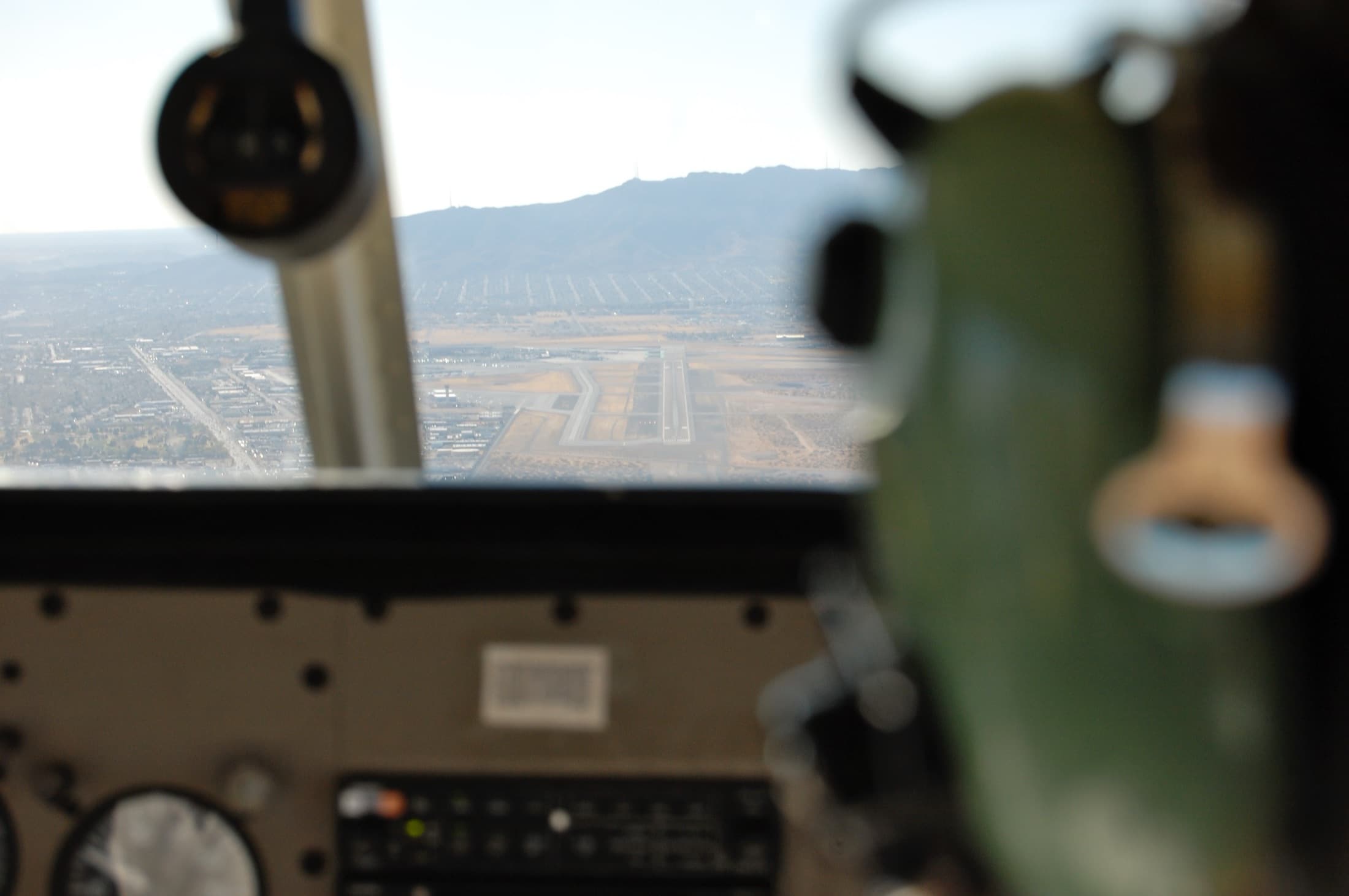

Could a passenger really land a plane?
It has happened. A handful of passengers have landed small airplanes with air traffic control talking them down, and one of them had never touched a control in his life. It has never happened with an airliner, and the reasons why are more interesting than the headlines. Here is what the real cases actually took.
The cleanest case: Palm Beach, May 2022
On May 10, 2022, a Cessna 208 Caravan was inbound to Florida from Marsh Harbour in the Bahamas when the pilot suffered a medical emergency and slumped over the controls. Darren Harrison, a passenger with no flight experience, got into a seat, keyed the radio, and told air traffic control his pilot was incoherent and he had no idea how to fly the airplane. The controller who ended up guiding him, Robert Morgan, was also a flight instructor. He had no time in a Caravan, so he pulled up an image of the airplane's panel layout and translated it into short, plain instructions about what to push, pull and flick.
Harrison flew the airplane to Palm Beach International and landed it, in AVweb's telling a slightly wobbly arrival by a passenger who stayed remarkably calm. The incident record shows three aboard, no injuries and no damage. It is the strongest data point the question has: a genuinely untrained passenger, a real airplane, a safe landing. It is also worth noticing what the case needed to work. Daylight. A calm passenger. A single-engine turboprop, not a jet. And, by pure luck, a controller who taught flying on the side.
The record before that: a night landing and a lapsed licence
The purest zero-experience case is older and less famous. In October 2013, John Wildey, a 77-year-old former Royal Air Force clerk who had flown often as a passenger but had never piloted an aircraft, was flying with a friend in a Cessna 172 over England when the friend collapsed. Humberside Airport called in flight instructors to talk him down over the radio. It took several circuits of the airport, and by the time he touched down it was dark. He described the result as a controlled crash; the airplane was down and Wildey walked away. His friend died. That is what the best version of this story looks like when the luck is thinner: an airplane on the ground in one piece, barely.
The third case usually cited is Doug White, who landed a King Air 200 at Fort Myers in April 2009 after the pilot died at the controls, with his wife and daughters aboard. White's own account is gripping, but he is the asterisk in the record: he held a private pilot certificate from 1990, in single-engine airplanes far simpler than a King Air, and controllers put him on frequency with a King Air instructor who relayed the critical steps. A lapsed licence pressed back into service is not a passenger in the sense the question means.
Why it has never happened in an airliner
Every one of those landings was a small aircraft with one pilot aboard. The airliner version of the story has never happened, and the industry is built so it never has to. Airliners fly with two pilots so that one becoming incapacitated is handled by the other, not by row 23. The flightdeck door is locked by regulation. And the machine itself is a different problem: a Caravan crosses the fence at highway speeds and forgives a firm arrival, while a jet approaches roughly twice as fast, with swept wings that punish getting slow, and a landing configuration that takes type-rated pilots weeks of training to manage.
The one modern airliner that flew with nobody able to fly it is the grim control case. In August 2005, Helios Airways Flight 522, a Boeing 737, failed to pressurize after a maintenance setting was missed, and the crew was incapacitated by hypoxia before they diagnosed it. The airplane flew on autopilot to its destination and circled until the fuel ran out. Nobody walked forward and saved it, because on a real airliner, with a locked door and no one to talk you through systems you cannot name, that is not how the story goes.
What the voice on the ground can and cannot do for you is its own question, with its own rulebook: can air traffic control talk you down? And since 2020 a few small airplanes carry an answer that needs no passenger at all: can a plane land itself?
One in three of you already said yes
In a January 2023 YouGov survey of about 20,000 Americans, 32 percent said they were confident they could safely land a passenger airplane in an emergency with air traffic control's help. Among men it was 46 percent. The record above says the answer is: in a small trainer, on a calm day, with the right person on the radio, a few people have. In an airliner, nobody ever has.
We built the testable version of the question. A Cessna 172 on final, a tower on the radio, 90 seconds. It models the two mistakes that actually end these flights: getting slow and pulling the nose up, or arriving too fast to stay on the runway.
In the browser, no login.
Doing it on purpose: private pilot, median published rates, 568 schools
Landing on purpose is most of what those hours buy. Instructors report six to 40 hours of lessons before a student's first solo. Checked October 20, 2026.
Opens the estimator.
Passenger landing questions
Has a passenger ever actually landed a plane?
Yes, in small aircraft. In May 2022 Darren Harrison, a passenger with no flight experience, landed a Cessna 208 Caravan at Palm Beach International after the pilot collapsed, with a controller who was also a flight instructor talking him down. In October 2013 John Wildey, a 77-year-old who had never piloted an aircraft, landed a Cessna 172 at Humberside Airport in England, in the dark, after his pilot friend collapsed. In April 2009 Doug White landed a King Air 200 after the pilot died, but White held a private pilot certificate, so his case is a lapsed licence pressed into service rather than a true zero-experience landing.
Has a passenger ever landed a commercial airliner?
No. There is no case on record of a passenger landing a jet airliner. Airliners fly with two pilots precisely so that one becoming incapacitated is an inconvenience, not an emergency: the other pilot lands. Every real passenger landing has been in a small aircraft with one pilot aboard.
Could air traffic control talk me through landing a 737?
They would try, but the starting conditions are far worse than the cases that succeeded. The flightdeck door is locked by regulation, the airplane flies roughly twice as fast as the trainers passengers have actually landed, and configuring a jet for landing involves systems that take type-rated pilots weeks of training to operate. Controllers are also not necessarily pilots; in the 2022 Palm Beach case the controller happened to be a flight instructor, which was luck, not procedure.
What plane did the passenger land in Florida?
A Cessna 208 Caravan, a single-engine turboprop, on May 10, 2022, at Palm Beach International Airport, inbound from Marsh Harbour in the Bahamas. The passenger was Darren Harrison. The controller who talked him down, Robert Morgan, was also a flight instructor, and because he had never flown a Caravan he worked from an image of the airplane's panel layout. Three people were aboard; nobody was hurt and the airplane was undamaged.
How hard is landing for real student pilots?
It is the skill that takes the most repetition. Working instructors report students needing anywhere from six to 40 hours of lessons before their first solo flight, and most of that time is landings. The FAA minimum for a private pilot certificate is 40 flight hours; examiner data puts the typical student closer to 72 at the checkride.
Sources for this page:
Controller details helping passenger land plane after pilot emergency (TODAY/NBC, May 2022)
Passenger Lands Caravan (AVweb, May 2022)
ASN Wikibase incident record: Cessna 208 Caravan N333LD, May 10, 2022
Unintentional King Air pilot: an interview with Doug White (AOPA, April 14, 2009)
'Hero' Passenger Lands Small Plane After Pilot Fell Ill (NPR, October 9, 2013)
Helios Airways Flight 522 accident overview (FAA Lessons Learned)
14 CFR 121.313, the locked flightdeck door rule for airline operations
Cost figures are medians of the rates in our cost report, computed at build, and are estimates, not quotes.