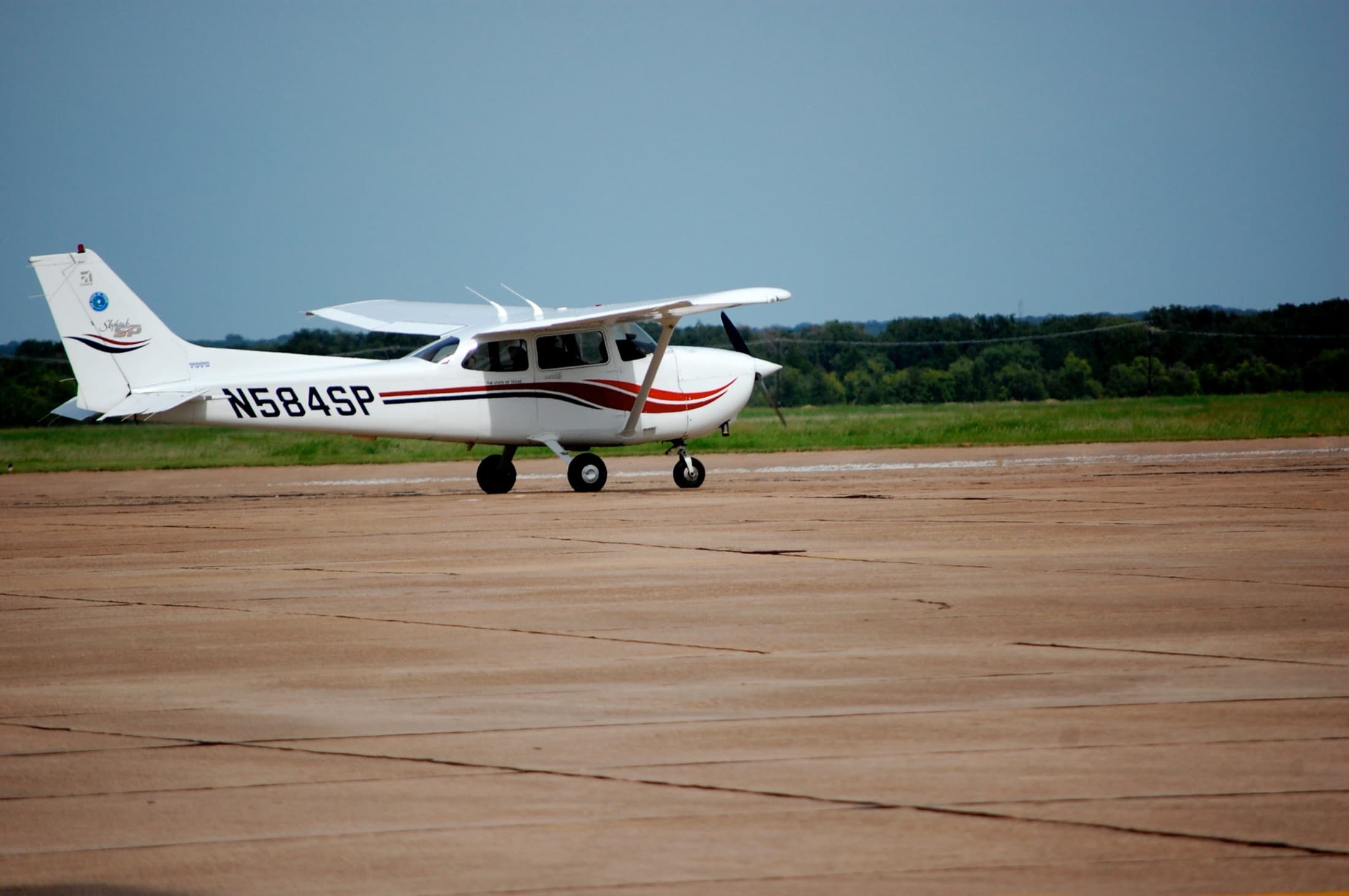

How to land a Cessna 172
The method below is the FAA's, from the Airplane Flying Handbook's chapter on approaches and landings: one speed rule, five phases, and a flare that takes longer to judge than anything else in early training. Reading it is not the same as flying it, which you can feel for yourself in the browser at the end. This page is not flight instruction.
One speed, held with the nose
A landing is set up long before the runway. The airplane is configured, trimmed, and flown down final at one steady speed: AOPA's published 172 procedures use 65 knots indicated with full flaps, and the FAA's stabilized-approach criteria allow plus 10 or minus 5 knots around the recommended landing speed, about 1.3 times the stall speed in landing configuration. The number for your exact airplane lives in its POH.
What holds that speed is the nose, not the throttle. Pitch down a touch and the airspeed rises; pitch up and it falls. The throttle then sets how steeply you come down onto the aiming point. That division of labor, nose for speed, throttle for the descent, is the two-sentence brief our game's tower gives every player, and it is the rule most failed approaches break first.
The five phases, and the ten seconds that matter
The handbook divides a landing into five phases: the base leg, the final approach, the round out, the touchdown, and the after-landing roll. The first two are flown with the speed rule above. The work is in the third: in roughly the last 10 to 20 feet the throttle comes to idle and the nose rises slowly, so the descent shallows and the airplane arrives in the landing attitude, main wheels first, with little or no weight on the nosewheel. Then you wait. The airplane settles as the speed bleeds, the wheels roll on, and the nose is held off until it comes down on its own.
The escape hatch on every approach is the go-around: power in, climb away, come back and try again. Instructors treat it as a normal outcome, not a failure, and the handbook prescribes it whenever the approach cannot be stabilized. Nothing about a landing is owed to anyone once the approach has gone wrong.
Every bad landing has a name
The handbook's catalog of faulty approaches and landings has named these for generations of students. Our 90-second landing test hands out a verdict for each one, so here is the FAA's name next to the words the game will use when it happens to you.
Getting slow
the card says: Stalled it.The nose comes up to stretch the glide, the airspeed decays, and the wing stops flying. Most approaches that fail, fail here.
Undershooting
the card says: Came up short.The descent is aimed short of the runway and never corrected with power. The handbook's fix is pitch and power together, back onto the glide path.
Floating
the card says: Ran off the end.Too much speed into the round out. The airplane skims above the runway, eating it, until the extra speed bleeds off. The handbook ties minimum float directly to approach-speed discipline.
Ballooning and bouncing
the card says: Hard landing.The nose comes up too fast in the flare and the airplane climbs away from the runway, or touches and leaps back into the air. Both end in a drop from a height the gear was not built for.
Porpoising
the card says: Nose wheel first.A bounced landing recovered badly: the airplane comes in nose first, then pitches through a series of jumps and dives on the nosewheel, the one wheel not built to land on.
Touching down in a drift or crab
the card says: Landed sideways.In a crosswind, the airplane meets the runway still moving sideways or with the nose pointed off the centerline. The landing gear takes a side load it cannot absorb.
Feel why each one happens
Our landing test puts you on final in a 172-class trainer with the two controls the rule is about: the nose and the throttle. Basic mode is calm air; advanced adds bank, rudder and a crosswind, where the sideslip in the FAQ below stops being theory. The tower coaches you the whole way down, and the result card names your error in the same words as the list above. It is a toy that stalls for the same reason a real wing does, not a training device.
In the browser, 90 seconds.
Whether someone with no training at all could pull a landing off, the documented cases: could a passenger really land a plane?
What landing practice costs, median published rates, 568 schools
Medians of the rates flight schools publish, from our directory. Most of the six to 40 hours before a first solo is landings. Checked October 20, 2026.
Opens the estimator.
Landing technique questions
What speed do you land a Cessna 172 at?
The number that governs is in the airplane's own POH, and AOPA's published 172 procedures use 65 knots indicated on final with full flaps. The FAA's stabilized-approach criterion is staying within plus 10 or minus 5 knots of the recommended landing speed, about 1.3 times the stall speed in landing configuration. That speed is held to the flare, not to the ground: the airplane touches down slower, as the speed bleeds off with the nose rising.
Why do you flare, and when?
The flare, the FAA's handbook calls it the round out, starts in roughly the last 10 to 20 feet. Power comes to idle, and the nose rises slowly from the approach attitude to the landing attitude, so the descent shallows and the main wheels touch first with little or no weight on the nosewheel. Flare too fast and the airplane balloons upward; too late and it arrives nosewheel first. Judging that transition is most of what students practice.
What happens if you come in too fast?
The airplane floats. Extra approach speed does not break anything, but the airplane keeps flying in ground effect past the touchdown zone while the speed bleeds off, and the runway behind you is gone. The handbook's answer is approach-speed discipline; the practical answer on a short runway is a go-around.
How do you land a 172 in a crosswind?
The technique in the FAA's handbook is the sideslip: lower the upwind wing enough to stop the sideways drift, and hold the nose straight down the runway with opposite rudder, all the way through touchdown, so the upwind main wheel meets the runway first with the airplane tracking straight. Touching down still crabbed or drifting is what side-loads the gear.
How many landings does it take to learn?
One instructor who kept notes on his students across 50 years put the threshold of solo competence near 55 takeoffs and landings, and working instructors report six to 40 flight hours before a first solo, most of it landing practice. The FAA minimum for the full private pilot certificate is 40 hours; examiner data puts the typical student closer to 72.
Sources for this page:
FAA Airplane Flying Handbook (FAA-H-8083-3C), Chapter 9: Approaches and Landings
Cessna 172 Private Pilot Procedures (AOPA)
Instructor studies students, predicts solos (AOPA, July 2016)
Speeds and technique are the handbook's and AOPA's, not ours; the POH for a specific airplane governs. Rate medians are computed from the published rates in our cost report at build, and are estimates, not quotes. This page is not flight instruction.